Wednesday, 12 June 2013

Evaluation


If I were going to do the project again in the future I would take my time management into consideration because I spent a lot of time researching and not enough time sampling and creating different ideas that could then be used on my final piece, I would also change how I did my final print, I would have rather used a screen than do it all by hand because it took up a lot of extra time that could have been spent on furthering and developing ideas to show that I have the skills and knowledge to do so. 

I think the whole area of tattoos and culture was a huge project I set myself to and in the future I'd like to set myself something more realistically challenging but so I can really focus on the skills I have to produce a lot more work within the set time frame.

The artists I chose to look at throughout the brief were Tyrone Appollis and Tinus de Jongh, I chose these two artists because they're both of an african background and I feel that looking at their work has inspired my own. I found that both artists used colours I could take and use for my own work to really capture that african feel.


Saturday, 8 June 2013

Research

African Scarring.

In Africa scarring is shown as a symbol of strength, fortitude and courage in both men and women. It is a permanent procedure to symbolize beauty and to decorate their body. The process in which they scar themselves involves cutting patterns into their skin. Different tools were used to make these scars.

Scarification effects were valued highly but the procedure was slow and painful, during this procedure it didn't only depend on the artists skill it depended on the person's pain tolerance. If a woman was eager to be scarred she would tolerate the pain and this showed that she had the emotional ability to bear children.

Body and facial scarring's made it possible to identify one tribe from another.

Although the art of scarification has fallen away from Africa different countries still believe that scarring is a way to decorate the body and proceed to do so.


Research

http://rattatattoo.com/top-10-tribal-tattoos/
The History of Tribal Tattoos

Tribal tattoos have existed for centuries, as indelible markings inked into the skin. On every continent, evidence has been found that reveals that tattoos were a part of almost every ancient culture. Tribal peoples all over the world created tattoo cultures independently of each other, which means that each continent has its own unique style of body art. Sometimes these ancient body markings used inks and powders to give the tattoos color, but often the tattoos were a form of decorative scarification.


Tribal tattoos generally consist of thick, dark lines in a dark ink such as navy blue, brown or black. Black ink is the most popular color for tribal tattoos as it creates the greatest contrast, giving the finished tattoo a clean, crisp edge. Tribal tattoos are most popular among men, especially among athletes and fighters. The most common areas of the body to have tribal tattoos inked are the back, chest and arms. Most tribal tattoos are large and masculine, entirely dominating an area of the body. Linear tribal tattoos often don’t work well with other tattoos, and so a tribal tattoo is difficult to cover up or add to. Once the tattoo has been inked, little more can be done to it except to have it removed or to re-ink it and refresh the color.


Research

Tyrone Appollis
Born 1957, Cape Town, South Africa

Tyrone Appollis started his art career as a painter and began sculpting in wood seriously from 1990. Currently he views himself as being a sculptor, painter, print-maker, poet and street musician. He considers political and social reconciliation to be a function of art – art as cross-cultural dialogue. Appollis has participated in numerous solo and group exhibitions in multi-media. These exhibitions have taken place all over South Africa as well as outside of its borders.

I chose to look at Tyrone Appollis because of the colours used in his work, with him being an African artist I found it helpful noticing that some of the colours he uses I could use for my own work to give it that vibrant feel of Africa. I also enjoy some of his black and white paintings because they have that African symbols within the painting and he has taken markings from the culture and used them in his work.


Wednesday, 15 May 2013

FMP

FMP

I took symbols from the Adinkra prints and symbols from the tribal prints for my final piece. I did a few samples before I went on to working on my metre of fabric.


Finally after sampling, I created a moodboard


And then moved on to my final piece


Tuesday, 14 May 2013

Adinkra

http://www.adinkra.org/htmls/tattoos.htm
http://www.adinkra.org/htmls/adinkra_index.htm
http://africanhistory.about.com/library/weekly/aaAdinkra.htm


Adinkra Symbology
The Origin and Meaning of Adinkra Symbols


Adinkra is a cotton cloth produced in Ghana and Côte d'Ivoire which has traditional Akan symbols stamped upon it. The adinkra symbols represent popular proverbs and maxims, record historical events, express particular attitudes or behaviour related to depicted figures, or concepts uniquely related to abstract shapes. It is one of several traditional cloths produced in the region – the other well known cloths being kente and adanudo.

The Akan people (of what is now Ghana and Côte d'Ivoire) had developed significant skills in weaving by the sixteenth century, with Nsoko an important weaving centre. Adinkra, originally produced by the Gyaaman clans of the Brong region, was the exclusive right of royalty and spiritual leaders, and only used for important ceremonies such as funerals – adinkra means 'goodbye'.

Over time the Asante further developed adinkra symbology, incorporating their own philosophies, folk-tales and culture. Adinkra symbols were also used on pottery, metal work (especially abosodee), and are now incorporated into modern commercial designs (where their related meanings give added significance to the product), architecture and sculpture.


Sunday, 5 May 2013

Research

Tinus de Jongh
Born 1885, Amsterdam

Self-taught, he began his career as a decorator in the Netherlands, and then pursued painting full-time. He achieved some note when the Stedelijk Museum in Amsterdam purchased one of his early pictures. He arrived in South Africa in 1921, the light and landscape of South Africa soon caused him to abandon his muted palette in favour of more saturated colours. His formulaic approach to painting Cape landscapes with gabled farmhouses created such a demand that he abandoned his considered brushwork in favour of a broader palette knife technique.
 
Although Tinus de Jongh's work is completely different to what I did with my work, his really captures the eye and I think that's what inspired me to make my work really powerful to look at. His work is very sharp, and that's exactly what I wanted my work to come across as.


Friday, 3 May 2013

Spider diagram

I made a spider diagram of all the different areas within the African culture to help me with research.

By making the spider diagram it was easier to find what I was looking for and it was easier to help me decide on what was important to research for my fmp fabric.

Tuesday, 30 April 2013

Spider diagram

Below is a spider diagram of all the ideas I came up with for the theme Journey.

I've circled the word Culture because that was the theme I chose, I chose culture because I figured that there are a lot of different ways I could create something from it. 

The culture I chose was African, as circled below, I chose this because by looking through books and doing research on the internet I came to find that it was the culture I was most interested in.

Thursday, 25 April 2013

Tattoos

Primary Research 

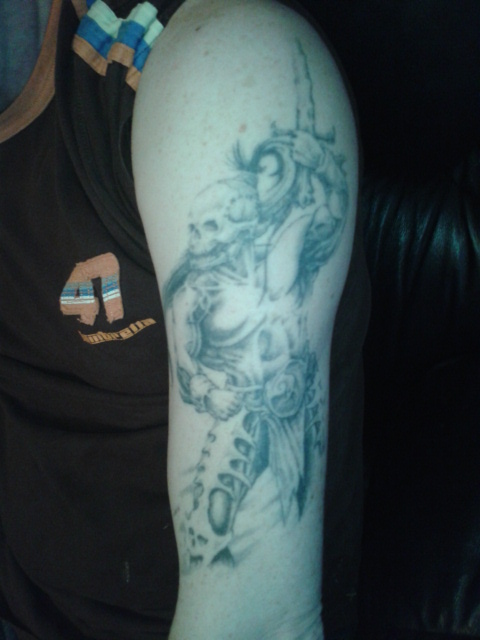
These are some photographs I have taken of my family and friends tattoo's


Tuesday, 23 April 2013

Tattoos


How fashion has been influenced by tattoos

Fashion has been influenced by tattoos in the 20th century. There are many different ways fashion has portrayed tattoos and maybe we don’t really notice it that much, but it’s there. Garments have been printed with tattoo styled images for example; t-shirts with the basic skull tattoo style print and pants with the sailor heart and anchor print. Although it might not be a big hit, the print is still around and still being sold in regular high street shops. In places like Korea, china and Japan it’s more recognised. 


Tattoos

http://fgarfias.wordpress.com/2009/03/19/the-technological-development-of-tattoos-through-history/

How it developed

People began to explore new places and got exposed to new things; tattoos also began to spread among non-third world countries. At first only sailors, pirates and convicts had tattoos. When the Industrial Revolution began to happen, more and more people decided they wanted to get tattoos. Now it wasn’t just freaks in freak shows, exiles and military getting tattoos. Women wanted to get tattoos, teenagers and even some wealthy businessmen.  Image has begun to change mainly due to the fact that so many people are getting tattoos. Many celebrities and rock stars have tattoos and we are greatly influenced by the media. Many teenagers are getting tattoos because they think it is “cool” and want to be like their idols on television and magazines. Teenage girls get them because they are “sexy” in certain parts of the body. Men get tattoos so that they seem tough and manly. Slowly they are becoming more accepted among today’s society. Soon, the majority of a certain generation will be tattooed, and then it will become an “accepted” art form.

Kinds of tattoos

Sailor, criminality and circus. Sailors often returned to port with tattoos they received during their voyage. These usually consisted of a extremely basic or primitive styles that used minimum amounts of detail thus making the tattoos look 2 dimensional or ‘flat’. These flat tattoos, today known as ‘flash tattoos’ often give a cartoon feel. The typical motifs would consist of flowers, hearts, mermaids, ships, anchors, snakes, birds, and names or script. Prison tattoos can be quite professionally done with homemade or improvised materials. These convey, in many cases, identity. A commonly known symbol for gang members are their tattoos. Receiving permanent markings on the body is a sign of absolute loyalty. These gang tattoos often speak volumes about the wearer, what gang they are in, what their ideologies or beliefs might be, what they have done, where they have been imprisoned or lived as well as details up to and including how many individuals the member is said to have killed. Known Western gang tattoo symbols include teardrops under the eye as well as spider webs on the elbows – these are said to symbolize that the wearer has killed. The prevalence of tattooing during the late 19th and early 20th century owed much to the once popular circus. When these traveling carnivals were prevalent tattooing, in turn, prospered. For nearly 100 years all major circus acts hired numerous individuals who were completely covered in tattoos.


Tattoos

http://en.wikipedia.org/wiki/History_of_tattooing

History of tattoos

The etymological origin of the word ‘tattoo’ is believed to have two major derivations; the first is from the Polynesian word ta which means striking something and the second is the Tahitian word tatau which means ‘to mark something’. The use of tattoos is recorded to have begun thousands of years ago and its history is as varied, colorful and diverse as the people who carry them. From a simple scientific standpoint – tattoos are created the insertion of colored materials beneath the skins’ surface or epidermis. The first tattoos were most likely created unintentionally. Someone with a small wound or gash happened to rub it with a dirty hand that was covered with soot or ash. Once the wound had healed, they realized that the skin had healed over the ash and that the mark became a permanent addition.

Our knowledge of tattooing in Europe really begins with the Ancient Greek and Roman historians. It is possible that tattooing cultures already existed in Europe before the last Great Ice Ace, 12,000 years ago. Bowls with traces of black and red pigments along with sharpened flint instruments were discovered in the Grotte des Fees (Fairy Grotto) in Chatelperron – France, 1867, and in caves in Portugal and Scandinavia. The shape and size of the tools suggest that they have been used for tattooing.

Where it went

Pazyryk Culture: In 1948 – just over 200 kilometers North of the borders between Russia and China – Russian archeologist Sergei Rudenko began excavating a group of tombs, or Kurgans, in the high Altai mountains. At this site mummies that date from around 2,400 years ago were excavated. On their bodies were wide arrays of tattoos said to represent various indigenous and mythological animals. Amongst them were griffins and monsters that were thought to have a magical significance yet some of these kinds of elements are believed to be purely aesthetic, decorative or ornamental. The tattoos of these mummies, when viewed together or as a whole piece, were believed to reflect the status of the individual bearing them.

Polynesia: Polynesian tattooing is considered the most intricate and skillful tattooing of the ancient world. Polynesian people, believe that a person’s mana, their spiritual power or life force, is displayed through their tattoo. The permanent marks left by the tattoo artists would forever celebrate their endurance and dedication to cultural traditions. Intricate patterns, mimicking woven reeds or other natural forms, graced men’s arms, legs, torso and faces. Women were generally tattooed on the hand, fingers and wrists and sometimes on their tongue.

North America: Early Jesuit accounts testify to the widespread practice of tattooing among Native Americans. Among the Chickasaw, outstanding warriors were recognised by their tattoos. Among the Ontario Iroquoians, elaborate tattoos reflected high status. In North-West America, Inuit women’s chins were tattooed to indicate marital status and group identity. New York City was settled up in 1846 and began a tradition by tattooing military servicemen from both sides of the civil war. Samuel O’reilly invented the electric tattooing machine in 1891.

Tattoos

http://en.wikipedia.org/wiki/History_of_tattooing

History of tattooing - Culture.

China

In ancient China, tattoos had been associated with criminals and bandits since at least the Zhou Dynasty (1045 BC to 256 BC). Tattooing Chinese characters such as "Prisoner" on convicted criminals' or slaves' faces was practiced until the last dynasty, the Qing Dynasty (1644 to 1912).

However, tattoos can be found to have been referenced in popular culture. Tattoos are present in one of the Four Great Classic Novels in Chinese literature, Water Margin, in which at least three of the main characters, Lu Zhishen, Shi Jin and Yan Ching are described as having tattoos covering nearly all of their bodies. Wu Song was sentenced to tattoo his face with his crime after having killed Xi Menqing to avenge his brother. In addition, Chinese legend has it that the mother of Yue Fei, a famous general of the Song Dynasty, tattooed the words "Jing Zhong Bao Guo" on his back with her sewing needle before he left to join the army, reminding him to "repay his country with pure loyalty".

Marco Polo wrote of Quanzhou "Many come hither from Upper India to have their bodies painted with the needle in the way we have elsewhere described, there being many adepts at this craft in the city."

Egypt and India

In northern India, permanent tattoos are called ""Godna."" Tattoos have been used as cultural symbols among many tribal populations, as well as the caste-based Hindu population of India. Henna and Mehndi were popular in ancient India and ancient Egypt, and still remain popular today in the Indian subcontinent, Middle East and North Africa.

Tattooing in the 21st century

During the latter decades of the 20th century tattooing became a popular social practice worldwide. Many younger (and some older) people today either have aspirations to have a tattoo somewhere on their body, or already have one or more. Some elect for one or several small tattoos such as butterflies, flowers, or other designs, while others may have significant portions of their skin covered. Popular along these lines are the 'half-sleeve', having the upper arm covered in tattoos, or 'full-sleeve', which includes the upper and lower arms. 
Whether or not to get a tattoo which is visible while wearing clothing is a matter of taste, but also involves consideration of future employment opportunities, and societal and family pressures.

It is assumed that the majority of tattoo recipients patronize tattoo parlors, which- according to varying state laws- have been registered and observe accepted standards of hygiene. However, some individuals do not, and some even use home tattooing equipment.
Over the past 50–100 years, it has become more acceptable for ordinary people to have tattoos and less so for the aristocracy - a reversal of the situation in the 19th and early 20th centuries. Tattoos are also used today as a sign of affiliation to certain street gangs and many are tattooed in prison as 'badge of honor' so that 'ex-cons' can recognize each other. Tattooing has also gained more popularity with women in recent years. Bodies of Subversion: A Secret History of Women and Tattoo, by Margot Mifflin, became the first history of women's tattoo art when it was released in 1997. In 2012, tattooed women outnumbered men for the first time in American history - according to a Harris poll, 23% of women in America had tattoos in that year, compared to 19% of men.  

Tattooing remains as the archetypal means of 'body painting' and decoration, and certainly the most permanent, and while the traditional popular designs appear to have been devised from 'heavy metal' and 'motorbike gang culture, these are slowly being replaced by more modern tattoo designs based upon Celtic, Indian and Asian themes in addition to floral and other natural images.

Monday, 22 April 2013

Tattoos

I decided to put a spider diagram together because it's more helpful to know what to research, I wrote down the most important points so I could go through them one by one to gather all the information I needed.

Sunday, 21 April 2013

Statement of intent

The title of my project brief is Journey, within this brief I will work towards creating a metre of fabric for my final piece by doing this I am going to gather different types of information on my chosen area for my journey.

I chose to look at tattoos and culture. I was influenced to look at tattoos because a lot of people I associate with have tattoos and I take a lot of interest in them. I started off by taking photographs of family and friends I knew who had tattoos and gathering up information about the history of tattoos, where it went, how it developed and how tattoos are now used within the fashion industry. While researching tattoos I was able to gather information about culture as well. This helped because I wanted to look at both tattoos and culture and how they came together. I noticed that I became interested in African culture and went into researching how tattoos were a part of African culture and how tattoos were used within tribes as symbols to identify one tribe from another.

During the project I researched African prints and markings to inspire me to create my own print for my final piece. I created some samples using wooden blocks and spray paint lids; using these materials created a great texture on the fabric and was perfect for the African look I wanted. I looked through books on African prints to get an idea of what colours were used so I could really get a feel for my own prints so they identified the culture correctly, I used bright colours like yellows and greens to give of a vibrant look which I felt identified the culture perfectly. 

Sunday, 24 March 2013

Abstract Artists

Jackson Pollock
http://www.foghound.com/blog/2012/09/28/jackson-pollock-painting-or-chessboard/
http://nazmiyalantiquerugs.com/moroccan-rugs-inspire-jackson-pollock-robert-motherwell-joseph-albers/
http://www.jacksonpollock.com/


He began to study painting in 1929 at the Art Students' League, New York, under the Regionalist painter Thomas Hart Benton. During the 1930s he worked in the manner of the Regionalists, being influenced also by the Mexican muralist painters (Orozco, Rivera, Siqueiros) and by certain aspects of Surrealism.
From 1938 to 1942 he worked for the Federal Art Project. By the mid 1940s he was painting in a completely abstract manner, and the `drip and splash' style for which he is best known emerged with some abruptness in 1947. Instead of using the traditional easel he affixed his canvas to the floor or the wall and poured and dripped his paint from a can; instead of using brushes he manipulated it with `sticks, trowels or knives' (to use his own words), sometimes obtaining a heavy impasto by an admixture of `sand, broken glass or other foreign matter'. This manner of Action painting had in common with Surrealist theories of automatism that it was supposed by artists and critics alike to result in a direct expression or revelation of the unconscious moods of the artist.

Monika Nieborek
http://fineartamerica.com/featured/hope-i-monika-nieborek.html
http://abstractartist.com/Monika_Nieborek.html
http://www.thedistrictartgallery.com/MONIKA-NIEBOREK.html


Monika Nieborek was born in Otwock, Poland. She began her studies in art at The University of Warsaw. Monika was inspired by nature and the beauty of her homeland. While in Eurpoe she created a series of paintings with organic subject matter using unique textures of various mediums. In 1994, Monika moved to the United States. She arrived in New York City where she pursued her love of art. Nieborek was thrilled to be surrounded by all of the galleries and museums New York had to offer. Monica was inspired by the local art scene and artists whom which greatly influenced her work. Along with paint she uses a numerous array of materials creating beautiful textures and compositions. She finds inspiration in simple found objects like paper, fabric, string or glue. Her palette explores all bold color combinations with accented highlights of bronze.

Kimberly Conrad
http://abstractartist.com/Kimberly_Conrad.html

 
Kimberly has been creating art in one form or another since she was a small child. Her career began in 1988 as a fiber/textile artist, and has continued to evolve in a variety of mediums through the years. She had the luxury of world travel, primarily Asia, in the late 80's and early 90's which greatly influenced her evolution as an artist. The artist has painted on most every surface imaginable, but at this time works primarily on canvas and board. Her style however, remains very diverse, therefore she is hesitant to attach her name to a particular category of art. Currently, she favors two specific, yet very different techniques. The "pouring" of acrylic and oil paint, allowing the paint to move freely, telling it's own story has become a great passion.
She is also known for her knife painted oils, more traditional pieces, bearing thick paint, and heavy texture. Regarding "Artists", the variety of influences has been just as diverse. She adores the works of Jackson Pollock, the energy and frenzy involved, as well the soothing, impressionistic strokes of those such as Cezanne, Van Gogh and Monet.

Sunday, 10 February 2013

Diet pills

http://www.annecollins.com/diet-pills.htm

Diet pills are very tempting things if you want to lose weight, especially if you have tried several conventional weight loss diets without success. There are two types: prescription-only diet pills and over-the-counter (otc) diet pills.

Prescription Diet Pills

These pills are diet drugs. These pills are regulated by the Food and Drug Administration agency (FDA), their side effects are monitored and they may be advertised and prescribed for weight loss under certain condition and in certain pill-dosages. Examples of prescription diet pills include brands like: Meridia (Sibutramine), Xenical (Orlistat), Adipex, Bontril, Didrex, Phentermine and Tenuate.

Diet pills are principally designed for those suffering from serious obesity - e.g. with a body mass index of 35+. Diet and weight loss drugs are not a cosmetic solution for weight loss, neither are they intended to replace convention diet and weight loss programs. Dieters who fail to lose weight on orthodox diet plans should not turn to pills as an easy answer to their weight problems. Instead they should continue with their weight loss diet and work on improving their motivation to lose weight and exercise.

Over-the-Counter Diet Pills and Weight Loss Supplements

The OTC diet and weight loss pills sector is probably the fastest growing sector of the weight loss industry. However, these diet pills are classified as food supplements rather than diet drugs, and are relatively unregulated. These diet pills are not tested by Federal authorities, not subject to the same advertising, dosage or labelling requirements as prescription diet pills, even though some experts consider that many OTC diet supplements and weight loss pills are (in reality) diet drugs.

Although many OTC diet pills and weight loss supplements contain ingredients with powerful amphetamine-like properties, and even though some of these diet pills have been associated with serious side effects including death, there is no compulsory reporting procedures for these diet products. OTC diet pills remain an unknown quantity.

Barbie - Facts.

For my recycle runway project my theme is recycled toys and I am focusing on Barbie and her life if she were real.

• If Barbie was a real woman, she'd have to walk on all fours due to her proportions.
• If Barbie were an actual women, she would be 5'9" tall, have a 39" bust, an 18" waist, 33" hips and a size 3 shoe.
• Barbie calls this a "full figure" and likes her weight at 110 lbs.
• At 5'9" tall and weighing 110 lbs, Barbie would have a BMI of 16.24 and fit the weight criteria for anorexia. She likely would not menstruate.

Wednesday, 16 January 2013

Elizabeth Couzins Scott

Elizabeth Couzins Scott
Recycle Runway

http://www.62group.org.uk/artist/elizabeth-couzins-scott/


Elizabeth is inspired by the dark side of experimental fashion design whose more conceptual designers have explored the symbolic and cultural meaning of consumer culture and contemporary anxieties. The interpretation of these themes by modern historians like Caroline Evans by way of mythology, identity and gender allows her to develop ideas into imagery using articles of clothing and accessories. During a recent residency she has been able to experiment with photo silkscreen techniques and has created a series of figurative work using dolls clothes and faces. This work discusses the current obsession for women to buy into the impossible beauty myth and the increased numbers of young women seeking cosmetic surgery procedures.


Elizabeth uses clothing and accessories to create objects to express her ideas concerning contemporary anxieties.

Her work can be linked with mine because she makes dolls heads and my theme for Recycle Runway is recycled toys/dolls.